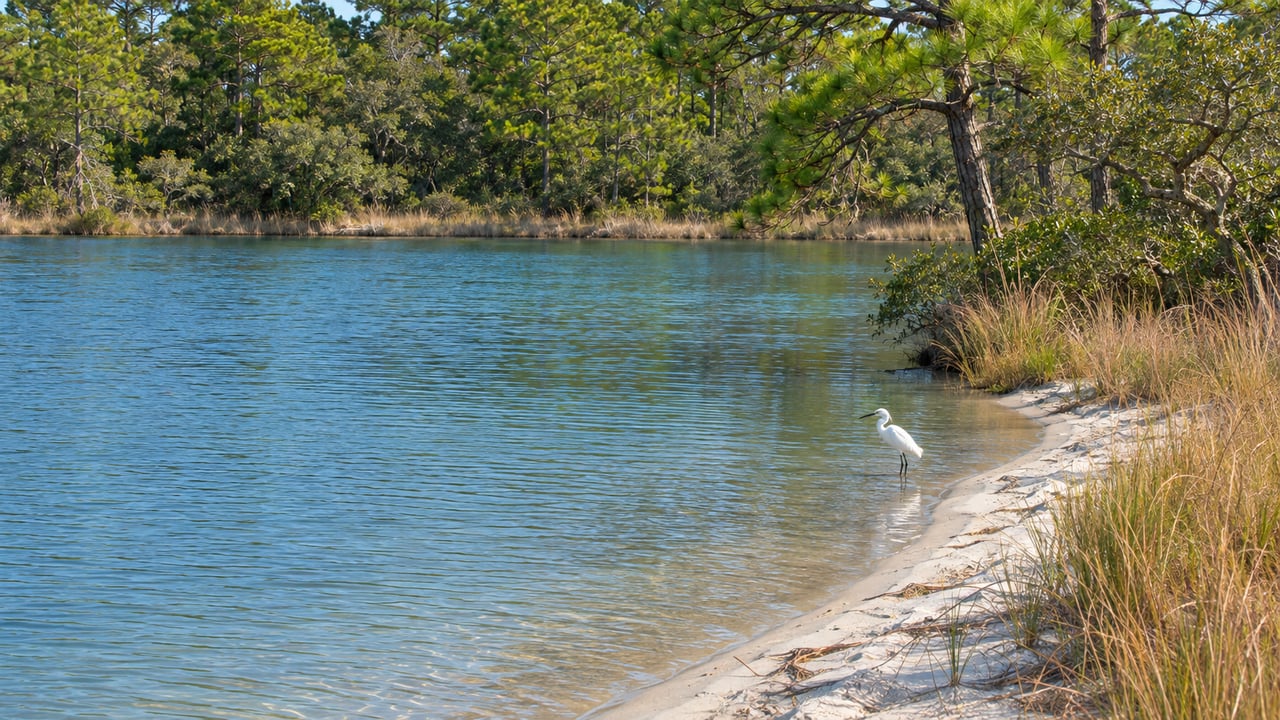
The Centennial Trail starts at the Jeff Friend trailhead on Highway 180 and runs about two miles west. It passes through dense maritime forest and sandy dune swales, crosses a coastal wetland, and ends at the Pine Beach Trail. Its winding boardwalk reaches into the quietest parts of the refuge. For years that boardwalk let one parking spot cover the whole refuge, from the Little Lagoon marshes to the Gulf beach.
The boardwalk is closed this winter. The U.S. Fish and Wildlife Service trails page says every trail is open "however, the Centennial boardwalks have been closed due to safety concerns." You can still walk the Centennial Trail "up to the boardwalk on both sides," and the agency says it is working on repairing and replacing those sections. For anyone at Retreat at Bon Secour heading west to the refuge that shares its name, the closure changes how a winter outing works. Bon Secour now functions as two separate walks, each with its own trailhead, its own habitat and its own winter birds.
The Two-Mile Link That Holds the Refuge Together
The Centennial Trail connects the Jeff Friend and Pine Beach trails, and its eastern end runs through forested wetlands. Without its boardwalks, those two trails don't connect. The trailheads are about three miles apart on Highway 180. Alabama Birding Trails puts the Pine Beach Trail 1.5 miles west of the refuge office and three miles west of Jeff Friend, on the south side of the road.
So walking from the forest to the beach now takes two parking stops. Choose which half of the refuge you want and drive to it. Walk the Centennial only as an out-and-back from whichever end you started at.
FWS still lists the full trail system: Centennial, Chan West Pine Beach, Gator Lake and Jeff Friend. Trails are open year-round from sunrise to sunset. They are built for foot traffic, and bicycles are not allowed.
Two Halves With Different Winter Birds
The split matters because the two ends of the refuge hold different birds in winter. The table below pulls from the Alabama Birding Trails site guides for each access point.
| Access point | Where you park | The walk | Winter birds and wildlife to look for |
|---|---|---|---|
| Jeff Friend Trail | 13900 AL-180, on the south side heading west | One-mile loop to the north shore of Little Lagoon | Bufflehead, Common Loon, Horned Grebe |
| Pine Beach Trail | Lot with an interpretive kiosk, 1.5 miles west of the refuge office | About two miles each way to the beach, past Little Lagoon and Gator Lake | Red-breasted Merganser, Bald Eagle, Peregrine Falcon on Little Lagoon's western shore; wintering ducks, grebes and alligators from the Gator Lake deck |
| Gator Lake Trail, from Mobile Street | Parking area about 0.75 mile down Mobile Street, on the left | Narrow trail linking Mobile Street to the Pine Beach Trail | Blue-gray Gnatcatcher, Golden-crowned and Ruby-crowned Kinglets, Yellow-rumped Warbler |
| End of Mobile Street | Public lot near the Gulf beach | Short walk to the beach | Common Loon, Northern Gannet, other seabirds and shorebirds; winter sparrows and waders in the swales along the road |
Three of the four rows are on the west side. Pine Beach, Gator Lake and Mobile Street are all within a short drive of each other at the western end of the trail system. Alabama Birding Trails describes Pine Beach as the trail that "will generally have the best birding on the refuge during migration and can also provide excellent winter birding opportunities." The west side also has the raptors: Bald Eagle and Peregrine Falcon along Little Lagoon's western shore.
The east side is smaller, but it has its own appeal. The Jeff Friend loop is a mile long. A small observation deck midway along the trail, accessible to visitors with disabilities, looks out over Little Lagoon and is a good place to set up a spotting scope for diving ducks and loons. Visit Gulf Shores & Orange Beach describes a wide, flat, wheelchair-accessible boardwalk with benches along the way. With the Centennial link closed, Jeff Friend works as a complete hour on its own. It doesn't have to be a warm-up for a longer hike.
The West Half Rewards a Second Parking Lot
Most of the winter birding is at the western end, and the trailheads there are close together. A full morning on the west side can look like this:
- Park at the Pine Beach lot. The kiosk has trail maps and bird lists. The trail heads southeast toward the beach by way of Little Lagoon and Gator Lake.
- Stop at Little Lagoon's western shore to look for mergansers and raptors. Then continue to the large observation deck near the bridge at Gator Lake to scan for ducks, grebes and alligators.
- Stay on the marked path near the beach. That stretch is a Snowy Plover nesting area, and Alabama Birding Trails asks visitors to obey all closed-area signs. Visit Gulf Shores & Orange Beach also lists sea turtles and the Alabama beach mouse among the species using those sections.
- Drive the short hop to Mobile Street, just west of the Pine Beach lot. Check the wetland swales for winter sparrows and waders on the way to the beach lot, then watch from the beach for loons and gannets.
Mobile Street has its own rules. Alabama Birding Trails notes private in-holdings along the road and asks birders to respect private property. It also urges caution around alligators in the marsh and palmetto stretches, some of which are fenced as a reminder to keep your distance.
For a shorter or more accessible outing, FWS lists the Gator Lake Trail as universally accessible and suitable for wheelchairs. It runs through maritime forest, wetlands and along Little Lagoon and takes about an hour.
A New Building, the Same Short Office Hours
There is a second change at the refuge this fall, and it affects anyone who wants to know when the Centennial boardwalks reopen. The refuge homepage announced that the refuge would begin moving into a new Visitor Contact Station the week of September 28, 2026, and that parking may be limited during the transition. Staff are on site Monday through Friday, 9 a.m. to 1 p.m., to answer questions, sell America the Beautiful passes and direct visitors to trails and beach access. If you have trouble finding the station, the refuge asks you to call (251) 540-7720.
The new building replaces offices that had worn out. An Interior Department Great American Outdoors Act fact sheet for Alabama says the refuge's headquarters and maintenance buildings had "reached the end of their life expectancy, have significant water damage and air quality issues," and no longer met the refuge's needs. The plan was to replace them with "a consolidated single facility" to improve both staff work and the visitor experience. The same fact sheet lists $1,919,000 for the project, with funding figures current as of March 2024. The Interior Department's photo feature for July 13, 2026 showed construction underway on the new headquarters and maintenance office.
The refuge's official address is 12295 State Highway 180 on the Fort Morgan Peninsula. The contact station is where to pick up maps, brochures and bird checklists. FWS also says it will post boardwalk updates on its trails page and social media. The station is staffed only on weekday mornings, so a Saturday visitor won't find anyone at the desk. A call before a weekday trip is the most direct way to learn whether the Centennial link has reopened.
The office is also the place to ask about programs. FWS says refuge staff, volunteers and partners offer guided bird walks, dune hikes and night prowls throughout the year. More than 370 bird species have been recorded on the refuge, and spring and fall are the peak seasons for neotropical migrants. The winter ducks, loons and raptors fill in between those seasons. "Bon Secour" comes from the French for "safe harbor," which fits a refuge that protects some of Alabama's last undisturbed coastal barrier habitat.
On a winter morning, a Bon Secour walk starts with choosing a parking lot. Jeff Friend gives you the quiet north shore of Little Lagoon and its diving ducks. Pine Beach and Mobile Street give you the eagles, the Gator Lake deck and the Gulf beach.
At Waterways of the Gulf Shore, the Scarbrough Team keeps track of the places just down the road from our neighbors, from the refuge trailheads to the marina. If you'd like to talk about life at Retreat at Bon Secour, Waterways and the western end of Gulf Shores, we'd be glad to have you over. Schedule a Consultation and we'll set aside a morning.