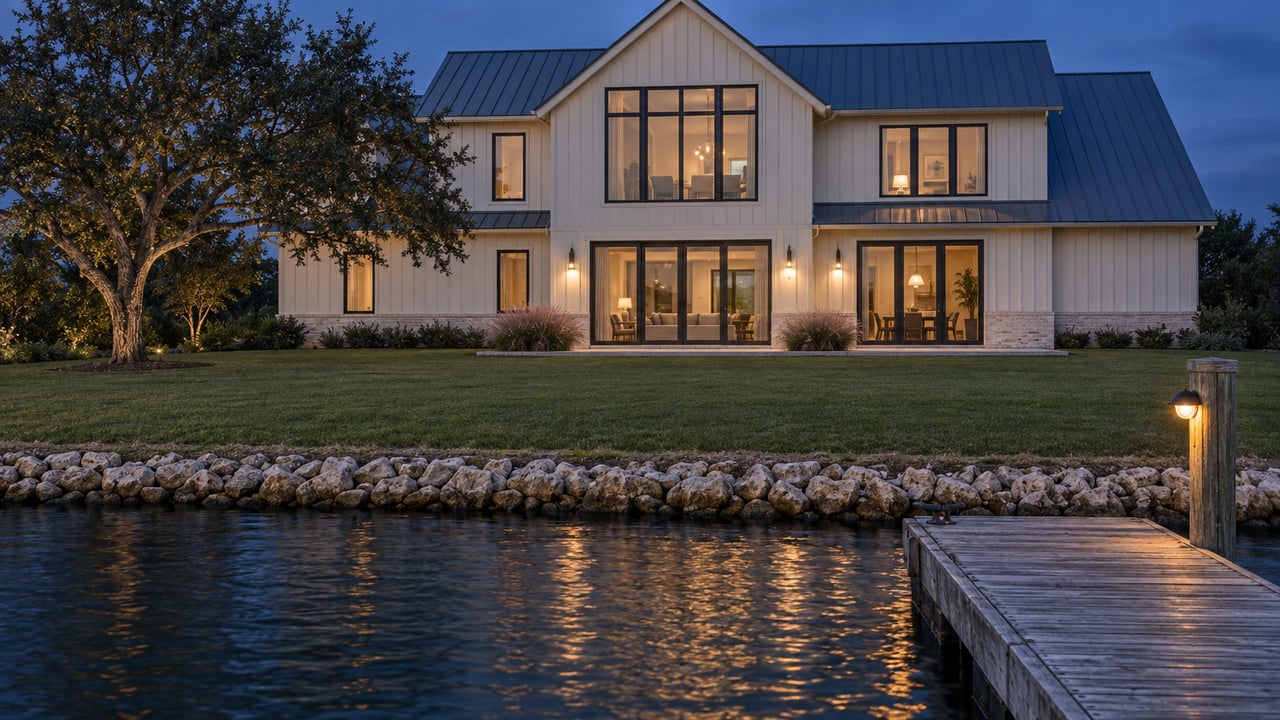
Walk the marina basin at Waterways any evening in late September and you will notice the light change before you notice anything in the water. The strings along the pergola are still doing their job, the pool deck is still glowing white under its usual fixtures, but the dock lights over the private slips are staying on longer into the night, and a few owners have started leaving them on well past the hour they'd bother with in July. Nobody posted a memo about this. It happens because the fish showed up first.
Alabama's fall fishing migration runs from September through November, with some movement continuing into December, as water temperatures drop and shrimp and baitfish start moving with the season instead of just riding out the heat. That shift changes what a dock light is actually doing after dark, and it changes what a person standing on their own slip at Waterways can expect to see in the water below them without ever untying a boat.
The Water Doesn't Look Different, But It Fishes Different
Nothing about the Intracoastal Waterway changes shape in October. The same channel runs past the same private slips it ran past in July. What changes is underneath the surface: cooling water pushes shrimp and baitfish out of their summer holding patterns and into movement, following the temperature drop toward deeper channels and protected water. Redfish and speckled trout follow the bait, not the calendar, which is why the fishing at a fixed dock can go from quiet to productive in the space of a few weeks without anyone doing anything different to the dock itself.
This is also the stretch when Alabama's Marine Resources Division and coastal guides start using the phrase "Red October" for what happens along the beaches and back bays, a period when redfish become genuinely easier to find in numbers, feeding on the shrimp and baitfish now moving through the same water a Waterways slip sits on.
What a Dock Light Is Actually Doing After Dark
A dock light does not attract redfish and speckled trout directly. It attracts plankton first, which draws in shrimp and small baitfish, which is what actually pulls in the predator fish that Waterways owners are hoping to see. The predators tend to hold at the edge of the lit water rather than in the brightest part of it, a boundary anglers call the shadow line, where they can watch baitfish silhouetted against the light and strike without exposing themselves.
In a Great Days Outdoors article, Foley angler Robert Dobson described his approach to night fishing:
"I use artificials at night. Live bait will work, but if redfish and speckled trout are around, they will hit a GULP on a jighead. My favorite is a three-inch GULP in natural color."
Dobson's other rule of thumb matters for anyone with a private slip: the better dock lights tend to be the ones positioned close to deep water, since shallow-water docks simply don't hold as many fish regardless of how bright the light is. A slip on the Waterways marina basin, sitting directly off the Intracoastal channel, starts from a stronger position on that front than a dock tucked into a shallow finger canal.
Red October, Not Just a Nickname
The nickname holds up because the timing lines up with real numbers. Speckled trout are managed under a six-fish daily bag limit with a 15 to 22 inch slot, though anglers can keep one fish per day larger than 22 inches. Flounder carry a five-fish bag limit with a 14-inch minimum. Anglers who land all three species, redfish, trout, and flounder, in a single outing get to claim what's known locally as the Alabama Inshore Slam, a target that gets noticeably more realistic once the fall run is underway.
Farther down the coast near Fort Morgan, boats work Dixey Bar at the mouth of Mobile Bay for the bigger bull reds that show up as part of the same fall push, proof that this isn't a phenomenon limited to any one stretch of water. It's coastwide, and a Waterways slip sits inside it rather than adjacent to it.
Here's a quick reference for what's actually in play this fall:
| Species | Fall pattern | Regulation to know |
|---|---|---|
| Redfish | Peaks in October ("Red October"), feeding on shrimp and baitfish moving through bays and channels | Part of the Alabama Inshore Slam |
| Speckled trout | Follows bait into deeper bays and rivers as water cools | 6 fish per day, 15 to 22 inch slot, one over 22 inches allowed |
| Flounder | Migrates toward the Gulf to spawn through fall | 5 fish per day, 14 inch minimum |
| Greater amberjack | Federal recreational season closes October 13 | 2026 season runs September 1 through October 13 |
That amberjack window closes October 13, which means anyone at Waterways who wants to run offshore for it this year has a defined and fairly short runway left.
The One Awkward Conversation Waterways Owners Skip
Anywhere else on this coast, a good lighted dock creates a small problem for its owner. Anglers actively look for docks with bright lights and good current, and homeowners who put in the effort to light their dock well often end up fielding boats idling nearby after dark, or improvising ways to discourage anglers from working water that technically belongs to someone's private property. It's a known friction point among waterfront homeowners generally, one that has nothing to do with the fish and everything to do with who gets to use the light once it's turned on.
That conversation doesn't come up the same way inside a private marina. The 40-plus deeded slips at Waterways sit behind a gated entrance, which means the dock light over a resident's boat is lighting up water that's already accounted for. Nobody has to decide whether to leave the porch light off to discourage boat traffic, because the traffic isn't wandering in from open water looking for a dock to work.
Getting the Light Right
Choosing a dock light is its own small decision, and it's a live topic among waterfront owners on this coast right now. A recent conversation between Alabama Saltwater Fishing Report host Butch Thierry and Craig Underwood of HydroGlow walked through the actual tradeoffs: above-water versus underwater systems, light color, how water depth and clarity change the right choice, and how to wire a system without creating a light so bright it becomes more of a nuisance than an amenity. For a Waterways owner deciding how to outfit a private slip, that's a more useful starting point than picking whatever fixture shows up first in a hardware store aisle.
When the Dock Isn't Enough
Some nights call for moving. Little Lagoon offers a different profile of water than the Intracoastal basin, especially once trout start holding tighter to deeper cuts as the fall progresses. Perdido Pass and the jetties on either side of it are a short run for anyone chasing the same fall pattern along moving water and structure. For bait and tackle before heading out, J&M Tackle on Canal Road stocks both inshore gear and offshore tackle, and Beach Bum Outdoors, positioned just before the Intracoastal bridge on Highway 59, keeps live shrimp and bull minnows on hand for anyone headed out for an evening run.
None of this requires leaving the neighborhood to enjoy. It just means the dock light over a Waterways slip is doing real work most nights this fall, whether or not anyone's standing there to watch it happen.
If you're already living the marina life at Waterways and want to talk about what a private slip means for your own boat, your own dock, and your own fall fishing routine, Waterways of the Gulf Shore is happy to walk through it with you.
This article is general information, not legal, tax or financial advice. Consult a qualified professional about your situation.